This blog post was prepared by Spencer Houghton, the National Digital Newspaper Program-Texas graduate student assistant.
In 1898, T. C. Nye sold his cattle ranch in the humid town of Cotulla, Texas, and bought an irrigated vineyard on the north side of Laredo in Webb County. Despite having a viticultural history reaching back to the late 1600’s, at that time, Texas was known for neither its grapes nor its wine. The three highest yield cash crops in 1898 were cotton, oats, and corn.
Nevertheless, T. C. Nye approached agriculture with the same bold prospect that a wildcatter approaches a field of untapped oil. Nye would make his money, not with cotton, oats, corn, or grapes, but with an entirely new crop to the area, the Bermuda onion.
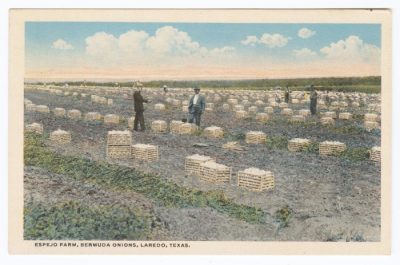
Originally taken from the island of Bermuda, the Bermuda onion was tested in Florida, the Carolinas , and Louisiana before finding a home in the silty, calcium rich soil that was shaped over thousands of years from deposits surrendered by the Rio Grande. As was articulated in a February 1910 issue of the Laredo Weekly Times, there is something about Laredo that makes “a better flavored onion.”
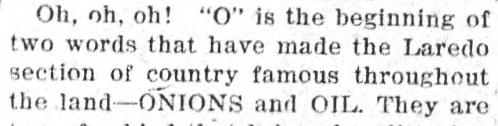
Over the next three decades, production increased from 64,000 pounds in 1899 to more than 90,000,000 pounds in 1930. The Laredo Weekly Times declared in 1923, “Oh, oh, oh! “O” is the beginning of the two words that have made the Laredo section of the country famous throughout the land ONIONS and OIL.” According to The Daily Tribune (Bay City, Texas) in 1928, “onion culture has made this territory an important factor in the nation’s onion supply.”
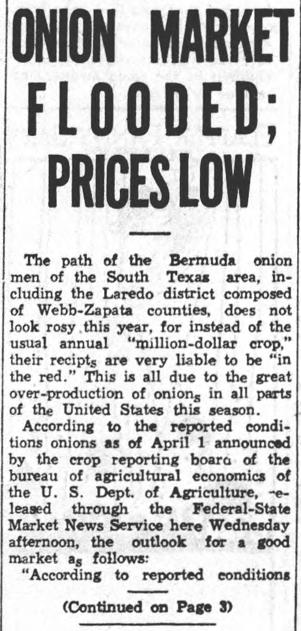
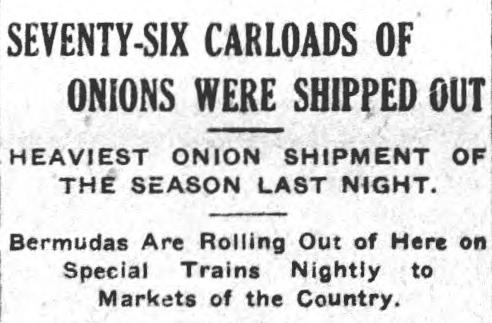
Though production had reached all-time highs by the mid-1930’s, profitability slipped to just above a 20-year low and both local and national markets were thoroughly saturated. The collapse culminated in a headline from the April 30, 1936, issue of The Laredo Times that read, “Government buying onions.” The industry had overextended itself and needed a bailout. As was reported in December 1936 by news outlets from as far away as The McKinney Examiner (McKinney, Texas), the “Onion outlook not so good in South Texas.”
What was once the land of “ONIONS and OIL,” became the land of oil, diversified agriculture, and international trade. Prosperity would continue for the town of Laredo, but in the wake of the 1936 collapse the Bermuda onion would lose its principal significance to the town’s booming agricultural sector.
For more information on the beginning of industrial agriculture in Southwest Texas, browse Chronicling America for more issues of The Laredo Times. If you’d like to visit The Portal to Texas History, you can learn more about the Bermuda onion from the Texas Department of Agriculture.
